
Zakat Eligibility: Complete Guide for Muslims
Zakat is one of the Five Pillars of Islam and a fundamental act of worship for every eligible Muslim. It requires giving a fixed portion of qualifying wealth to those in need every year. But before you calculate zakat how much to give zakat, you first need to answer a more basic questions — are you eligible to pay Zakat at all, and who around you is eligible to receive it?
Understanding Zakat eligibility is more important than most people realise. Paying Zakat incorrectly — whether by missing qualifying assets, using wrong Nisab values, or giving to ineligible recipients — means your religious obligation may not be fulfilled. Getting eligibility right is the foundation of everything. This guide explains Zakat eligibility in plain, simple language. Whether you are figuring out if you need to pay Zakat this year, or trying to understand who you can give it to, this article covers everything you need to know — grounded in Islamic principles and designed for everyday readers in India
What Does Zakat Eligibility Mean?
Zakat eligibility refers to the conditions that determine two things: who must pay Zakat, and who is allowed to receive it. These are two separate and equally important sides of the same obligation.
On the paying side, eligibility is governed by specific criteria set out in Islamic law — including a minimum wealth threshold, type of assets owned, and how long those assets have been held. A Muslim who meets all these conditions is obligated to pay Zakat. Those who do not meet the conditions are not required to pay that year.
On the receiving side, Islam has identified eight categories of people who are entitled to receive Zakat. Not everyone in financial difficulty qualifies — there are clear guidelines. Understanding both sides of Zakat eligibility ensures that this great pillar of Islam is observed correctly and that its benefits reach the right people.
Zakat Eligibility Criteria Explained
Let’s take a closer look at each of the key Zakat eligibility criteria so you can apply them to your own situation.
The Nisab Requirement
Nisab is the minimum wealth threshold that triggers the Zakat obligation. There are two Nisab values — one based on gold (87.48 grams) and one based on silver (612.36 grams). If your total zakatable wealth is equal to or greater than either of these values at current market prices, you cross the Nisab threshold and Zakat becomes due.
In India, most scholars recommend using the Silver Nisab because it is lower, which means more Muslims fall within the Zakat obligation and more people ultimately benefit. For example, if silver is trading at ₹285 per gram, the Silver Nisab would be approximately ₹1,74,522.
Which Assets Are Zakatable — and Which Are Not?
This is where most people have questions. Not everything you own counts towards Zakat. Islamic law draws a clear distinction between productive / liquid wealth and personal-use assets.
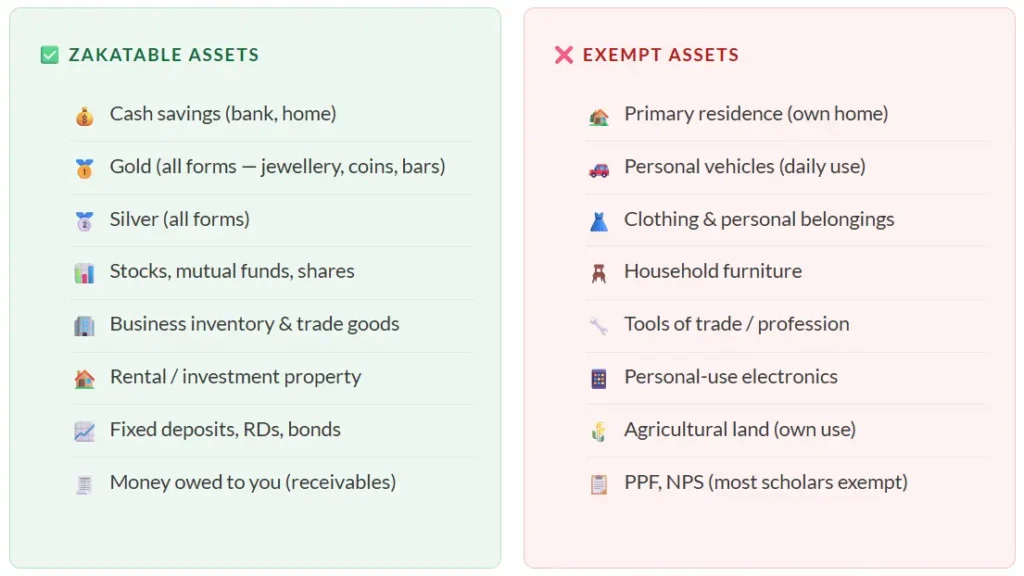
A commonly misunderstood point: gold jewellery is Zakatable in most scholarly opinions — including the widely followed Hanafi school. Even if your family wears that jewellery regularly, 2.5% Zakat is due on its total market value, provided the combined weight exceeds the Nisab. Use our Gold Zakat Calculator for a precise figure.
The Hawl — One Lunar Year Rule
Your qualifying wealth must have been in your ownership continuously for one full lunar year (about 354 days) before Zakat becomes due on it. If you acquired significant wealth shortly before your Zakat date, it may not yet be subject to Zakat. The key rule is that your wealth must remain at or above Nisab from the start of the year to the end.
Who Qualifies for Zakat?
Any Muslim who meets the six conditions outlined above qualifies to pay Zakat. This includes people from all walks of life — not just the very wealthy. Here are some common examples of people who qualify for Zakat:
Salaried Employees
If you receive a monthly salary and your total savings, gold holdings, and other zakatable assets across the year exceed the Nisab threshold, you are eligible to pay Zakat. Many working professionals in India qualify because they have savings in bank accounts and gold jewellery in the family.
Business Owners
If you run a business and hold unsold stock, inventory, or trade goods, the market value of those goods is zakatable. Business owners often have significant zakatable wealth in the form of stock and receivables, making them highly likely to qualify.
Gold Owners
In India, holding gold is extremely common, especially in the form of jewellery. If the total value of your gold — whether worn or stored — meets or exceeds the Nisab, you are eligible to pay Zakat on it. This is one of the most common qualifying factors for Indian Muslims, particularly women with inherited or purchased gold.
People with Savings
If you have accumulated savings in a bank account or fixed deposit over the past year, and those savings combined with your other zakatable assets exceed the Nisab, you are obligated to pay Zakat. Even modest savings can push someone above the threshold when combined with gold or silver holdings.
Who Is Eligible to Receive Zakat?
The Quran (Surah At-Tawbah, 9:60) identifies eight specific categories of people who are eligible to receive Zakat. This is not a matter of personal discretion — Islam has clearly defined who qualifies. Here are all eight categories:
| Category | Explanation |
| Al-Fuqara (The Poor) | People who have little or no income and cannot meet their basic daily needs. |
| Al-Masakin (The Needy) | Those who have some income or assets but still fall short of meeting basic living requirements. |
| Al-Amileen (Zakat Workers) | Administrators and collectors who manage the distribution of Zakat on behalf of the community. |
| Al-Muallafat al-Qulub | New Muslims or those whose hearts are being drawn toward Islam through support and reconciliation. |
| Ar-Riqab (Freeing Captives) | Historically used to free enslaved people. In modern times, this may apply to those in bonded labour situations. |
| Al-Gharimin (Those in Debt) | People who are burdened with debt they genuinely cannot repay and need support to become financially free. |
| Fi Sabilillah (Cause of Allah) | Charitable, educational, and Islamic causes that serve the broader Muslim community. |
| Ibn as-Sabil (Stranded Travellers) | Travellers who are away from home and have run out of funds, unable to access their own resources. |
In practical terms, for most Muslims in India the most common and relevant recipients are the poor (Fuqara), the needy (Masakin), and those burdened by debt (Gharimin). Zakat can be given directly to qualifying individuals or through trusted Islamic organisations that distribute it correctly
Who Is Not Eligible to Receive Zakat?
Just as important as knowing who can receive Zakat is knowing who cannot. Giving Zakat to an ineligible person means the obligation is not fulfilled. The following groups are not eligible to receive Zakat:
- Wealthy individuals: Anyone who owns wealth above the Nisab threshold cannot receive Zakat, as they are themselves obligated to give it.
- Direct family dependants: A husband cannot give Zakat to his wife, and a person cannot give Zakat to their parents, children, or grandparents — since they are already obligated to support them financially.
- Non-Muslims: Zakat is specifically for Muslims, although voluntary charity (Sadaqah) can be given to people of any faith.
- Descendants of the Prophet (Banu Hashim): Scholars from the Hanafi, Shafi’i, and other schools hold that the family of the Prophet Muhammad (peace be upon him) should not receive Zakat.
- Mosques and buildings: Zakat cannot be used for construction of mosques, Islamic schools, or general infrastructure unless the institution specifically channels it to eligible human recipients.
Examples of Zakat Eligibility in Real Life
Sometimes the easiest way to understand Zakat eligibility is through real examples. Here are three practical situations Indian Muslims commonly face:
Example 1 — Person with Savings
Fatima is a teacher in Chennai. She has ₹1,80,000 in her savings account and 30 grams of gold jewellery. The Silver Nisab today is ₹1,74,522. Her total zakatable wealth (cash + gold value) exceeds the Nisab and she has held it for over a year. Fatima is eligible to pay Zakat and must calculate 2.5% of her total qualifying wealth.
Example 2 — Business Owner
Tariq runs a textile shop in Surat. He has ₹4,00,000 worth of unsold fabric stock and ₹75,000 cash in his business account, minus ₹50,000 in trade debts he owes. His net zakatable wealth is ₹4,25,000 — well above Nisab. He is eligible to pay Zakat on his business assets.
Example 3 — Gold Owner
Rukhsana in Hyderabad inherited 120 grams of gold from her mother two years ago. She does not have significant savings, but the gold alone — valued at current market rates — exceeds the Gold Nisab of 87.48 grams. Rukhsana is eligible to pay Zakat on the full value of her gold.
Common Mistakes in Understanding Zakat Eligibility
Many Muslims make avoidable errors when assessing their Zakat eligibility. Knowing these mistakes in advance helps you get it right from the start.
- Ignoring the Nisab threshold: Some people calculate 2.5% on whatever wealth they have, without first checking if they actually cross the Nisab. If you are below Nisab, Zakat is not due at all.
- Forgetting gold jewellery: Many Indian Muslims assume that regularly worn gold is exempt. The majority of scholars rule that all gold — worn or stored — counts toward the Nisab and is zakatable.
- Not completing the lunar year: Zakat is not due on wealth you have held for less than one lunar year. Counting newly received money or gifts as part of your annual Zakat calculation can lead to errors.
- Miscounting zakatable assets: People sometimes forget to include fixed deposits, recurring deposits, business stock, or receivable debts. All of these count.
- Giving Zakat to ineligible recipients: Paying Zakat to family members you are obligated to support, or to wealthy friends, does not count. Always verify that the recipient falls within the eight eligible categories.
- Using outdated Nisab values: Nisab changes daily with gold and silver prices. Using last year’s figure can lead to incorrect eligibility decisions.
Pro Tips for Determining Zakat Eligibility
- Pro Tip 1 — Check your Nisab every year on the same date. Do not assume your eligibility from last year applies automatically — gold and silver prices change.
- Pro Tip 2 — Include all your gold. In India, gold jewellery is often overlooked. Weigh all your gold and calculate its current market value as part of your Nisab check.
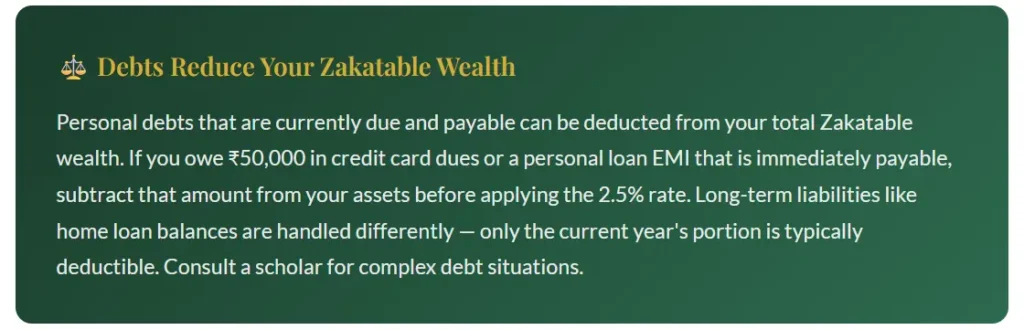
- Pro Tip 3 — Deduct your debts first. You are allowed to subtract debts you are due to repay from your total zakatable wealth before deciding if you have crossed Nisab.
- Pro Tip 4 — Keep a simple Zakat record. Write down all your assets and their values once a year on your chosen Zakat date. This makes checking eligibility fast and accurate.
- Pro Tip 5 — Use the Silver Nisab. Since the Silver Nisab is lower than the Gold Nisab, it ensures you do not miss your obligation when your wealth is in a moderate range.
- Pro Tip 6 — Verify recipients before giving. Before handing over Zakat, confirm that the person or organisation you are giving to falls within the eight Quranic categories.
Why Understanding Zakat Eligibility Is Important
Zakat is not just a personal religious act — it is a collective system designed to reduce poverty, redistribute wealth, and build a caring Muslim community. When Zakat is paid by every eligible Muslim and reaches every eligible recipient, it creates a powerful safety net for the most vulnerable.
In India, where economic inequality remains a serious challenge, Zakat has the potential to make a meaningful difference in millions of lives. But this can only happen when Muslims understand eligibility correctly. Paying Zakat when you are not eligible, or withholding it when you are, both undermine the system.
Understanding Zakat eligibility also deepens your own faith. It connects you to one of Islam’s greatest principles — that wealth is a trust, not an entitlement, and that part of it always belongs to those in need.
How Zakat Calculators Help Determine Eligibility
Calculating Zakat eligibility manually — especially when you have multiple assets like gold, savings, business stock, and investments — can quickly become complex. This is where a reliable online Zakat calculator makes a real difference.
A good Zakat calculator does more than just apply the 2.5% rate. It helps you check whether your total wealth meets the Nisab threshold, guides you through every category of zakatable assets, allows you to deduct eligible debts, and then tells you your exact Zakat amount.
Zakatcalc.in is India’s dedicated Zakat calculation platform, built specifically for Indian Muslims. It offers:
- Daily updated Gold and Silver Nisab values based on current Indian market rates.
- Separate calculators for gold, silver, cash, salary, and business assets.
- Clear step-by-step guidance so anyone can check their eligibility in minutes.
- A completely free tool with no sign-up required.
Whether you are checking eligibility for the first time or have been paying Zakat for years, Zakatcalc.in takes the guesswork out of the process. Visit zakatcalc.in to check your Zakat eligibility today.
Explore Related Tools & Guides
🧮 Main Calculator⚖️ Nisab Calculator🥇 Gold Zakat🥈 Silver Zakat
💼 Salary Zakat🏢 Business Zakat📋 Zakat Rules India📖 Complete Guide
Frequently Asked Questions (FAQ)
Q: What is the minimum wealth required to be eligible for Zakat?
A: Your total zakatable wealth must equal or exceed the Nisab threshold. The Nisab is either 87.48 grams of gold or 612.36 grams of silver, calculated at current market prices. In India, the Silver Nisab is commonly used, which works out to approximately ₹1,74,522 when silver is at ₹285 per gram.
Q: Is a salaried person eligible to pay Zakat?
A: Yes. If your combined zakatable wealth — including savings, gold, and other qualifying assets — exceeds the Nisab threshold and has been in your possession for one full lunar year, you are eligible to pay Zakat regardless of whether you are salaried or self-employed.
Q: Can I give Zakat to my brother or sister?
A: Yes, you can give Zakat to a sibling who is poor or in need — as long as you are not financially responsible for their upkeep. Siblings do not fall under the category of direct dependants in most scholarly opinions, so giving Zakat to a needy sibling is permitted and actually highly encouraged.
Q: Is gold jewellery counted for Zakat eligibility in India?
A: Yes. The majority of Islamic scholars hold that gold jewellery — whether worn regularly or stored — is zakatable and counts toward both the Nisab threshold and the total zakatable wealth. This is especially relevant in India, where gold jewellery is widely held by Muslim women.
Q: Can I give Zakat to an organisation instead of an individual?
A: Yes, you can give Zakat to a trusted Islamic organisation, but only if that organisation specifically collects and distributes it to the eight eligible categories of recipients. Zakat cannot be used for mosque construction, general running costs, or infrastructure projects.
Q: Does Zakat become due if I just received a large sum of money?
A: Not immediately. For Zakat to be due, the wealth must have been in your possession for one complete lunar year. If you received a large amount recently, that amount will become zakatable at the next Zakat anniversary date — as long as your total wealth remains above Nisab throughout that year.
Q: What if my wealth drops below Nisab during the year?
A: If your wealth falls below the Nisab threshold at any point during the lunar year, the Hawl (one-year cycle) is broken and Zakat is not due. The cycle restarts when your wealth rises above Nisab again and remains there for a full lunar year.
Conclusion: Zakat Eligibility
Zakat eligibility is not complicated once you understand the core principles. If you are a Muslim adult of sound mind, and your zakatable wealth — gold, silver, cash, savings, or business assets — has exceeded the Nisab threshold for one full lunar year, Zakat is obligatory for you.
On the receiving side, Islam has clearly defined who qualifies through the eight Quranic categories. Giving Zakat to the right people ensures your obligation is fulfilled and that the funds truly serve those who need them most.
Take the time each year to check your eligibility carefully. Use updated Nisab values, include all your qualifying assets, deduct legitimate debts, and verify your recipients. When Zakat is calculated and distributed correctly, it becomes one of the most powerful tools for social good that Islam has given to the world.
| 🌙 Check your Zakat eligibility today at https://zakatcalc.in/Free, accurate, and updated daily with India gold and silver rates. |